

Deep within the shadows of a city sewer, a fragile feline named Jenny was making a desperate bid for survival. Malnourished and alone, Jenny had been living in harsh conditions before she was spotted and carefully rescued by animal welfare volunteers. When she arrived at a local animal shelter, the team discovered something unexpected—Jenny wasn’t just fighting for her own life; she was pregnant.
The shelter staff knew that for Jenny to make it through labor, she first needed to regain her strength. They provided her with round-the-clock care, nutritious food, and a safe environment to rest. Days turned into weeks, and the once-frail Jenny gradually began to show signs of recovery. However, her road to improvement wasn’t without setbacks. Initially terrified of humans and other animals, Jenny remained withdrawn, hissing at anyone who approached. But with time and patience, Jenny slowly emerged from her shell and began to trust again.
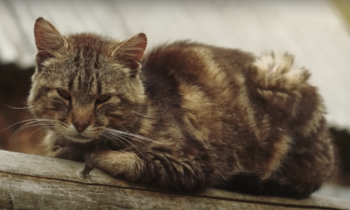
Just when the shelter celebrated her behavioral progress, Jenny suddenly began to act out of character—she stopped eating, became reclusive, and showed clear signs of distress. The volunteers, concerned by this shift, realized what was happening: Jenny was going into labor.
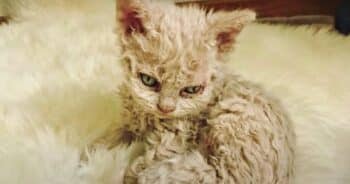
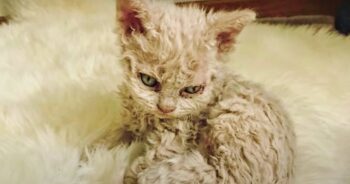
A few days later, Jenny became a proud mother to five healthy kittens. Among the litter, four appeared typical—but one particular kitten stood out immediately. This little one had an unusual trait that no one had seen before: her fur was curly, almost as if she had a natural perm.
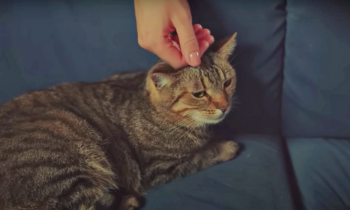
This kitten, with her unique coat, baffled the veterinarians at the shelter. Her fur texture was unlike anything they had observed in domestic cats. Curled in tight waves, it looked as though she had walked straight out of a salon. Concerned, the vet conducted a comprehensive health evaluation—but the results came back normal. The kitten was perfectly healthy. Her appearance, while rare, had no impact on her well-being.
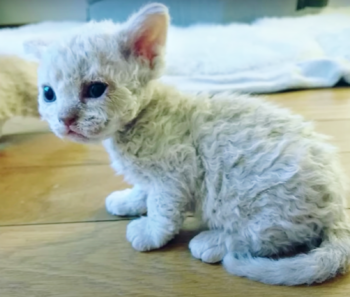
The staff decided to consult with a feline genetics expert and experienced cat breeder, hoping for answers. Yet even the expert, with decades of experience, couldn’t offer an explanation for the kitten’s curly coat. Nevertheless, she was smitten with the kitten’s charm and beauty. She called her “the most stunning feline” she had ever seen and decided to adopt her.
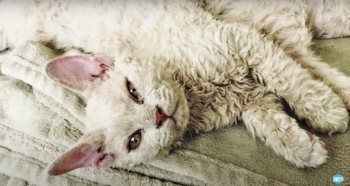
Feline scholars and breeders continue to speculate about the possible genetic causes behind this kitten’s curly coat. Some believe it could be a rare natural mutation related to the Selkirk Rex or Devon Rex gene, breeds known for their wavy and curly fur. Without a DNA test, it remains a mystery—but one that adds even more wonder to the tale of Jenny and her extraordinary kitten.
This heartwarming story is a powerful reminder of how resilience, care, and compassion can come together to create miracles—even in the most unexpected places like a sewer.


Facebook Comments